Showing posts with label homework. Show all posts
Showing posts with label homework. Show all posts
Wednesday, May 14, 2014

Why are Climate Models so Important?
Here are a few common questions about climate models and the answers as to why they are so important!
Saturday, May 10, 2014
Why Did The Vikings Leave Greenland?
Here is my explanation as to why I think they abandoned their settlements and went back to Europe!
Monday, May 5, 2014
High Profile Scientific Publications
Here is my document discussing the publication by Marcott et al. and how it was interpreted in the media.
Tuesday, April 22, 2014
Tipping Points
The tipping points that I found in Emanuel (2007), UC Berkeley News Center, and Scientific American:
- Periodic oscillations of the Earth's orbit that primary effects the Earth's orientation
- Water vapor accumulates in the atmosphere, causing the atmosphere to warm, allowing more water vapor to accumulate
- Ice and snow can accumulate, making it's way toward the equator. The ice and snow would reflect sunlight back into the atmosphere causing the planet to continue cooling
- Arctic Sea ice has essentially diminished past a certain threshold, claiming that it will be a relatively rapid increase to losing all of the ice
- Major changes in the ocean currents or air circulation
- Ocean temperatures or acidity
Friday, April 18, 2014
Monday, April 7, 2014
Tree Rings
Tree rings are one of the many proxies used to estimate the past's climate changes. As a tree grows in a year it produces a new ring, which varies in width allowing us to estimate the climate due to how much the tree grew. The trees that we focus on are normally found in a temperate climate, where they have a dry season. The trees that do not have a dry season end up growing year round and that makes it hard to determine any climate changes because the rings are not defined to one per year. The trees growth are influenced by precipitation, temperature, sunlight and wind. All of these factors can help us determine the climate of that specific growing season. Trees can grow for thousands of years and hold data from all of the past climates. When the tree rings are thicker that normally points toward a climate that favors the growth of the trees, while having narrow means the opposite. With the amount of data that has been collected scientists are able to estimate from hundreds to thousands of years in the past locally. By combining this proxy with other proxies scientists have been able to estimate regional and global climates.
Friday, April 4, 2014
Climate Change Videos
For the first video, located here, I feel as though the main take home message was that before humans were involved, there was a clear pattern that the Earth was going through. The globe would cool down and have an inter glacial period and then warm back up. Then from that point on it would cool down until another ice age occurred, and this pattern continued. Since humans have been involved, the amount of CO2 in the air has sky rocketed, and doesn't look like it is going to shrink any time soon.
In the second video, which you can find here, the sole purpose of this video also seemed to be toward end. With all of the data that paleoclimatologists gather from proxies such as corals, ice cores and tree rings the temperature of the globe is still hotter than the past thousand years. Even with the room for error, this still holds true. Between the first and the second video, there is a strong motif of the fact that the planet is a little off it's regular course.
The main idea for the third video, found here, seemed to be that the climate of the environment around lakes impact the lake itself. When the climate is warmer it effects the plants and their growth as well as the particles that are spread into the water.When these are measured you are able to find out information about the environment during a specific time period.
Saturday, March 29, 2014
Bradley: Natural Archives, changing climates
Overall I believe that the lecture was interesting and intense. If I could ask him any two questions it would be these:
1. What about the places that do not have ice there? How do we help determine the climate in those areas?
2. Where are the places that hold the oldest ice?
Both of these questions I feel would be interesting to have answered by Ray Bradley. I would like to know these answers because they personally interest me when it comes climate change and paleoclimatology.
Saturday, March 22, 2014
What Caused the Ice Ages?
In order for the Ice Ages to occur, it was not just a simple cause and effect. There are four things that have to occur before an Ice Age begins. The first thing that needs to be set up would be the boundary conditions. This means that the position of the continents would have to be further north, to allow an ice sheet to be formed. Also having tectonic plates collide, creating mountains, would emit less CO2 in the air. The second thing needed is the trigger, which has to do with the Earth's rotation around the Sun. With the boundary conditions pushing the Earth towards a tipping point, a small trigger like the Earth being just a little bit farther from the Sun can trigger dramatic changes. Feedbacks occur when the ice and snow cause the Earth's albedo to reflect more of the energy and absorb less. This causes the planet to get colder, pushing it to create more snow and continue the effect. The tipping point then occurs as the snow and ice begin to build up, the globe gets colder and glaciers begin to form. This is how the Ice Ages began.
 The Figure above shows the variation that the Earth can have when orbiting the Sun. When Earth becomes too far away, it creates a great environment to host an Ice Age.
Source: here

Source: here
Tuesday, March 18, 2014
Paleoclimatology
What is paleoclimatology?
Paleoclimatology is the study of past climates. By determining what had happened in the past, scientist hope to understand better what the future may hold for us.
How is it studied?
You can find different chemical and physical alterations around the world that show the previous climates and how the ocean land and air were affected. Some of the things studied are able to determine a characteristic that is world wide and others are for specific regions. "Proxy" records is the name of the things that scientists find in the environment. Proxy records are the records found in tree rings, in the skeletons of the coral reef, ice cores from glaciers and sediments buried in the ocean and land.
Why is it studied?
Studying this helps scientists reconstruct the past in order to help determine what may happen in the future or with human influence. It has already been previously shown using paleoclimatology that the Earth's climate can dramatically change within a matter of decades. Paleoclimatology also shows us the human influence that already exists on the Earth.
Monday, March 17, 2014
The Climate was Cooling? Wait what?
Yes, it is true. In the mid 20th century the globe was actually cooling due to aerosol emissions. The globe only cooled about 0.1 degrees Celsius, but this was a huge change in the trend of the 20th century. The aerosols had such an influence on the climate because it has direct and indirect effect. The aerosols were put in the atmosphere primarily from burning fossil fuels. The primary idea from reading this article and this article is that the cooling during this time was unexpected and was very confusing at first. When the scientists were able to study it more once they realized it was a hiatus, it became more evident that the sulfate aerosol emissions that us humans were producing. The skeptical science website and the article by Jeff Tollefson both seem relatively reliable. I personally felt like the article used more facts and science to make complete sense out of the subject. Tollefson is a reporter for Nature magazine, which is a well known and highly reliable source.
Sunday, March 16, 2014
Feedbacks- What Exactly Are They?
Feedbacks can be hurtful and push the climate more towards global warming, but they can also be helpful by cooling the planet and attempting to balance global warming out. Feedback occurs when a change in our climate causes another change in climate. There are two kinds of feedback, positive and negative. Negative means that the feedback is going against the trend in climate. This means that if the globe is warming, this feedback would cause the climate to cool. A positive feedback means that the feedback further pushes the current trend of the climate. If the climate was warming, this feedback would further push the climate towards warming. Feedbacks have the ability to dramatically effect the climate, which is what makes them so important. The more that scientists understand about feedbacks, the more that they are able to make future climate predictions. The ice albedo feedback refers to the light that is reflected on Earth's surface, which is a positive feedback. This means that surfaces that have a higher albedo like ice and snow will reflect more sunlight into space. The Arctic is an example where the snow is melting due to global warming. The land and ocean absorbs more energy, which in turn causes the globe to warm even further. As the globe continues to warm, more land is exposed which is causing global warming to get worse.


Source: here
Friday, March 14, 2014
Ice Cores and Why They're Awesome!
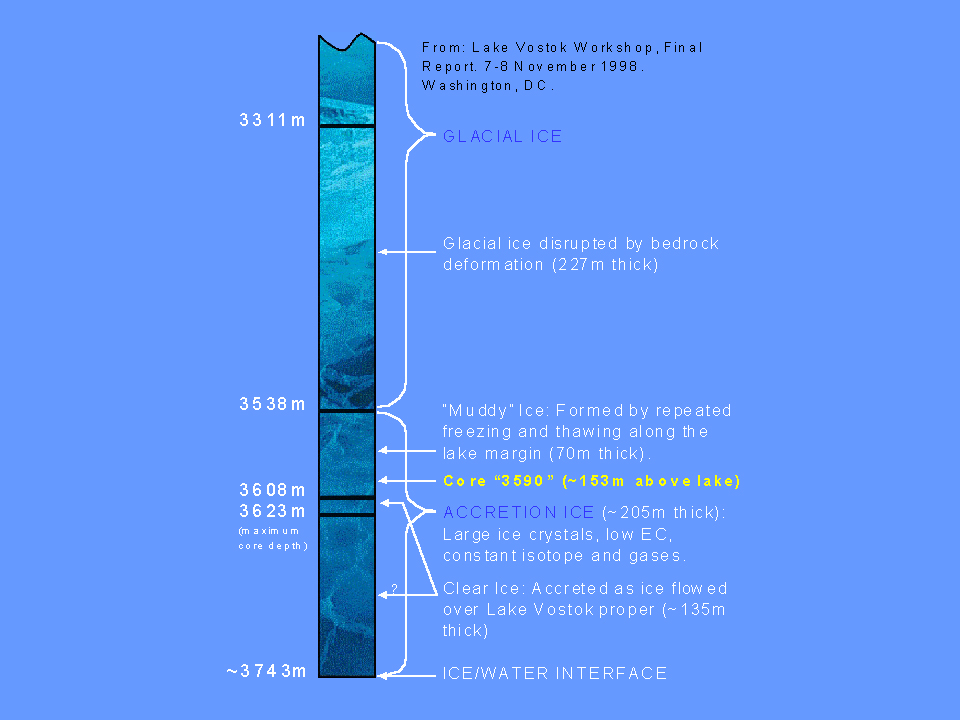
The cool thing about ice in the arctic and other cold areas is that snow/ice layers on top of each other throughout the year. The snow and ice tell a lot about the temperature because in these frigid areas, the snow and ice don't actually melt. This allows the people analyzing the ice to help determine temperatures and climate of that certain layer. The snow varies in chemistry, as well as winter snow being different than the summer snow. Light and heavy oxygen can be found within the ice cores which can help indicate the climate and atmosphere for that time period. The snowfall collects dust, human pollutants, sea salt, ash and gas bubbles which then get preserved and can now be analyzed. Ice cores can be used to reconstruct temperatures, precipitation, volcanic eruptions and even forest fires. The way that ice cores are formed allow them to be easily read by showing distinct seasonal markers.
An example of an ice core is below:
 Source: here
An example of an ice core is below:
Ocean Sediments---Looking for a Job!
Ocean sediments looking for a job! Help-out the poor ocean sediments and create a Linkedin profile for them. You can do that directly in Linkedin and post the link on your blog or create a blog post with what you would post on Linkedin.
- Why are you special?
I am special because I am found within the ocean, which is a large portion of the Earth. This means that there is a lot of information that I can share. I can be found in the shells of tiny animals and plants that had a calcium carbonate shell.
- What skills, expertise, and characteristics do you have?
I can tell a lot about the chemistry as well as the temperature of the ocean. I also have the ability to tell you a lot about wind and water currents.
- What sets you apart from other job candidates (aka proxies)?
I can tell a lot of different things that other proxies cannot, mostly about the ocean. This means I can show when the ocean was cold and when it was warmer. I can also tell the chemistry of the water at certain periods in time.
- What are your ideal challenges where you can really excel?
I would like to be able to characterize the oxygen levels in my sediments. Oxygen can either be heavy or light and I would like to sort it in to categories, which I am very good at. I would also excel at dating these oxygen samples.
- Where would you like to work?
My ideal place to work would be on the ocean floors, I feel like I would be able be most beneficial if stationed there.
Friday, February 28, 2014
Bathtub Model
The bathtub model can be used to explain the climate and different futures. I personally like this model because it is easy to understand and the concept allows you to play with different situations in order to determine the outcome. For example, the first tub that was shown was a tub at an equilibrium state. In this state the amount of water being put in the tub is the same amount that is leaving the tub. This allows the water in the tub to stay at a constant level. Comparing this to the environment, if humans were not on this planet, the atmosphere would be at an equilibrium due to the natural processes on Earth. Another situation that can occur for Earth is that more carbon dioxide being put into the atmosphere than it is being taken out. This would mean turning up the faucet on the bathtub. This would cause the tub to over fill. This simulates when humans began using machines and producing carbon dioxide, putting more in than the natural amount. The opposite could also occur, where more carbon dioxide is being taken out than is being put in. The additional amount of carbon dioxide being added by humans can also be shown in this model by adding a second faucet. This would show that carbon dioxide is being put into the atmosphere by multiple sources. Some plants and oceans are partially absorbing some of the extra CO2, which can be represented by more holes on the bottom or larger hole. Additional bath tubs can be added to the circuit in order to represent other parts of the carbon cycle. You can then change the input and output of the water in the tub in order to coordinate it with the emissions. This is a nice representation of the Earth's atmosphere and the multiple influences that cause it to warm up or cool down. This can be used to predict or visualize the future outcomes if we lower our emissions, keep them the same or even make them greater.

What is the big connection between climate change and extreme weather events and disasters?
- Based on what you just saw and read - how would you answer this question?
There is definitely a connection between climate change and the extreme weather events/ disasters. There are going to be years where extreme conditions occur. But when these conditions are record breaking, more that regular, that is when you can draw connections. With climate change, the globe is heating, causing more rain in certain places, more drought in other places and sometimes more extremes/disasters. There is no significant amount of proof saying that they are 100% connected, but there is nothing to prove that is not.
- What are the connections? Does it even matter?
The most recent extreme weather disasters like Hurricane Sandy or all of the wildfires occurring, are not necessarily pure coincidence. There is proof that climate change has been linked to multiple heat waves. When it comes to linking climate change to specific hurricanes or droughts is where it becomes particularly shady. Personally, I don't feel as though we need to necessarily prove the connection between the two at this current moment. The extremes are causing people to open up their eyes enough to see that the climate is changing. Although there is no proof that the extreme weather is directly associated with climate, there is enough there to convince people it is.
- Is there a good analogy you can use to illustrate the connections?
The connections between climate change and the extreme weather patterns/disasters are like human emotions and different scents. It is believed that different scents make us feel different ways. How else would Yankee Candle be so popular? This is called aromatherapy. Although there way not be significant proof of this method, people still use candles and other scents to manipulate their emotions. There are scents that relax you, make you sleepy, give you more energy and other things. Although there is no real direct science, there is no science proving that it is not true. This is very similar to climate change and weather. Although there is no proof that the global warming is causing extreme weather, there is nothing saying that it is not.
- And - who is Kevin Trenberth?
He is a senior scientist with the federal government's national center for atmospheric research, He is originally from New Zealand, as well as a former rugby player. He also earned his doctorate degree from MIT. He has spent a significant amount of his career studying variability in climate but has recently switched to studying the global water cycle and how it is responding to climate change. He is currently leading a world climate research program.
Montreal Protocol VS Kyoto Protocol
It is sometimes said that the Montreal Protocol did more to slow climate change than the Kyoto Protocol - how is that possible?
- About 40 years ago, it was discovered that there were pollutants in the air called chlorofluorocarbons that are slowly but surely eating away at our ozone layer. The ozone layer that is being affected is what protects the Earth from harmful radiation, and if it does not stop disappearing, everyone would be severely affected by illnesses and skin diseases. In 1990 the Montreal Protocol was announced, which was enforced by many nations and allowed countries to stop using CFC's. This completely prevented us from losing our ozone layer. The building up to the Montreal Protocol first began in 1974. Two scientists, Sherwood Rowland and Mario Molina, discovered that CFC's have the ability when sprayed to be carried up miles into the atmosphere. When there and mixed with the sun's UV rays, there was a chemical reaction that caused the depletion of the ozone layer. As this layer began to weaken, more UV rays were able to reach the Earth's surface. Although most of the companies that used or sold CFC's stopped using them, companies that completely depended on it decided to take more risks. These would be the companies that produced air conditioners or refrigerators. These companies began to rise again, and by the mid-1980s, the CFC level was peaking again. This caused a strong danger to our ozone level once again. A curve ball hit the scientists again when a large hole in the ozone was discovered above Antarctica. This added more urgency to the already pressing situation. The plan was to phase out CFC's with a ten year plan, being the Montreal Protocol. In 1990, after the Protocol was passed, they refined the agreement to a three part plan. This reflected what they wanted, but differentiated the responsibilities. Another protocol, the Kyoto Protocol was another plan to slow down and hopefully stop global warming. The Kyoto Protocol was developed after Montreal, and only included a control over greenhouse gases. The Montreal Protocol covers greenhouse gas emissions as well as other substances that negatively affect the atmosphere. This is mainly why it seems as though the Montreal Protocol was more effective in slowing the climate than the Kyoto Protocol. CFC's were proven to be very influential on our planet's atmosphere and had a huge impact. Once these chemicals were removed, our climate change crisis was sufficiently slowed.

This Figure shows the two possible futures that we could have had, whether or not the Montreal Protocol was founded. This focuses on the Chlorine concentration, which is not restricted under the Kyoto Protocol.
Source: here
Monday, February 24, 2014
Fixing the Communication Failure
- What is cultural cognition?
Cultural cognition refers to the influence of group values on risk perceptions and related beliefs. These group values reflect on equality, individualism, authority and community.
- How does protective cognition manifest itself in the context of climate change science?
It is the main cause of political conflict over the credibility of scientific data on climate change and other environmental risks.
- Explain the two specific techniques suggested for improving scientific communication.
One method is to explain information in a way that affirms peoples beliefs rather that threatens them. This is because people tend to reject information that may prevent them from doing activities that are valued by their group. But in the other hand if they are also presented information that upholds their commitments then they are more likely to be open-minded about the subject. The second technique is to make sure that the evidence is backed up by a diverse panel of experts.
- What, unfortunately, is the reality of most scientific communication.
The method is to normally flood the public with as much information as possible, assuming that all of the truth will drown out the lies.
Subscribe to:
Posts (Atom)